

What Is It Called When You Scan A Check In A Cash Register
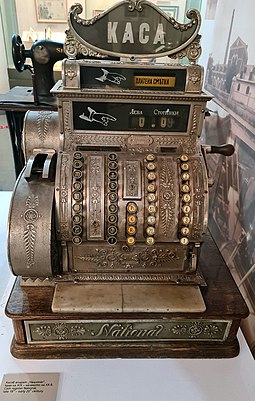
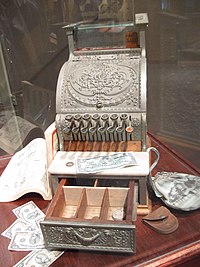
National greenbacks annals from the end of the 19th century, National History Museum, Sofia.
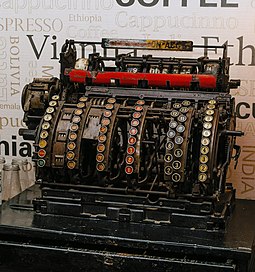
Antique cash register in a cafe, Darjeeling
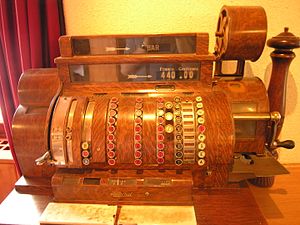
Antique crank-operated cash annals
A cash register, sometimes chosen a till or automated money handling system, is a mechanical or electronic device for registering and calculating transactions at a point of sale. Information technology is usually attached to a drawer for storing cash and other valuables. A modernistic cash register is usually attached to a printer that can print out receipts for record-keeping purposes.
History [edit]

An early on mechanical cash register was invented past James Ritty and John Birch following the American Civil War. James was the owner of a saloon in Dayton, Ohio, Us, and wanted to stop employees from pilfering his profits.[3] The Ritty Model I was invented in 1879 after seeing a tool that counted the revolutions of the propeller on a steamship.[4] With the aid of James' blood brother John Ritty, they patented it in 1883.[5] [6] It was called Ritty'southward Incorruptible Cashier and information technology was invented to cease cashiers from pilfering and eliminate employee theft and embezzlement.[7]
Early on mechanical registers were entirely mechanical, without receipts. The employee was required to band up every transaction on the register, and when the total cardinal was pushed, the drawer opened and a bell would ring, alerting the manager to a auction taking place. Those original machines were nothing but elementary calculation machines.
Since the registration is washed with the process of returning modify, according to Nib Bryson odd pricing came nigh considering by charging odd amounts like 49 and 99 cents (or 45 and 95 cents when nickels are more used than pennies), the cashier very probably had to open the till for the penny alter and thus announce the sale.[8]

Shortly after the patent, Ritty became overwhelmed with the responsibilities of running ii businesses, then he sold all of his interests in the cash register business to Jacob H. Eckert of Cincinnati, a china and glassware salesman, who formed the National Manufacturing Company. In 1884 Eckert sold the company to John H. Patterson, who renamed the visitor the National Greenbacks Annals Company and improved the cash register past adding a paper whorl to record sales transactions, thereby creating the journal for internal accounting purposes, and the receipt for external accounting purposes. The original purpose of the receipt was enhanced fraud protection. The business possessor could read the receipts to ensure that cashiers charged customers the correct amount for each transaction and did not embezzle the greenbacks drawer.[ix] Information technology also prevents a customer from defrauding the business by falsely claiming receipt of a bottom amount of change or a transaction that never happened in the beginning place. The offset prove of an actual cash annals was used in Coalton, Ohio, at the old mining visitor.
In 1906, while working at the National Cash Annals visitor, inventor Charles F. Kettering designed a cash register with an electric motor.


Various types of modern cash registers.
A leading designer, builder, manufacturer, seller and exporter of cash registers from the 1950s until the 1970s was London-based (and afterwards Brighton-based[10]) Gross Cash Registers Ltd.,[11] [12] founded by brothers Sam and Henry Gross. Their cash registers were particularly popular effectually the fourth dimension of decimalisation in Uk in early 1971, Henry having designed one of the few known models of cash register which could switch currencies from £sd to £p and so that retailers could easily change from one to the other on or afterwards Decimal Day. Sweda also had decimal-gear up registers where the retailer used a special key on Decimal Day for the conversion.
In current employ [edit]
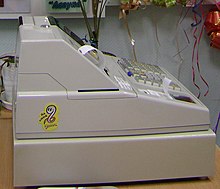
In some jurisdictions the law too requires customers to collect the receipt and keep information technology at to the lowest degree for a short while afterward leaving the shop,[xiii] [14] over again to check that the store records sales, so that it cannot evade sales taxes.
Ofttimes cash registers are fastened to scales, barcode scanners, checkstands, and debit carte du jour or credit carte terminals. Increasingly, dedicated cash registers are beingness replaced with general purpose computers with POS software. Cash registers use bitmap characters for printing.[15]
Today, point of auction systems scan the barcode (usually EAN or UPC) for each item, retrieve the price from a database, summate deductions for items on sale (or, in British retail terminology, "special offer", "multibuy" or "buy one, get 1 free"), calculate the sales tax or VAT, calculate differential rates for preferred customers, actualize inventory, time and appointment stamp the transaction, record the transaction in detail including each item purchased, record the method of payment, keep totals for each product or type of production sold too as full sales for specified periods, and do other tasks as well. These POS terminals will ofttimes besides identify the cashier on the receipt, and carry additional information or offers.
Currently, many cash registers are private computers. They may be running traditionally in-house software or general purpose software such every bit DOS. Many of the newer ones take touch screens. They may be connected to computerized point of sale networks using any type of protocol. Such systems may exist accessed remotely for the purpose of obtaining records or troubleshooting. Many businesses likewise employ tablet computers every bit greenbacks registers, utilizing the auction organisation equally downloadable app-software.[16]
Cash drawer [edit]
Cash registers include a cardinal labeled "No Sale", abbreviated "NS" on many modernistic electronic cash registers. Its function is to open up the drawer, printing a receipt stating "No Sale" and recording in the annals log that the register was opened. Some cash registers crave a numeric countersign or physical primal to be used when attempting to open the till.
A greenbacks annals's drawer tin only be opened by an didactics from the cash register except when using special keys, generally held by the owner and some employees (e.g. managing director). This reduces the corporeality of contact most employees take with greenbacks and other valuables. It also reduces risks of an employee taking coin from the drawer without a record and the owner's consent, such every bit when a customer does not expressly inquire for a receipt but still has to be given change (cash is more than hands checked against recorded sales than inventory).
A cash drawer is usually a compartment underneath a greenbacks register in which the cash from transactions is kept. The drawer typically contains a removable till. The till is unremarkably a plastic or wooden tray divided into compartments used to store each denomination of bank notes and coins separately in club to make counting easier. The removable till allows coin to exist removed from the sales floor to a more secure location for counting and creating depository financial institution deposits. Some modern cash drawers are individual units dissever from the rest of the greenbacks register.
A cash drawer is usually of strong construction and may exist integral with the register or a separate piece that the register sits atop. It slides in and out of its lockable box and is secured by a spring-loaded grab. When a transaction that involves cash is completed, the register sends an electrical impulse to a solenoid to release the catch and open up the drawer. Cash drawers that are integral to a stand up-alone register often have a transmission release take hold of underneath to open the drawer in the event of a power failure. More than advanced cash drawers take eliminated the transmission release in favor of a cylinder lock, requiring a cardinal to manually open the drawer. The cylinder lock commonly has several positions: locked, unlocked, online (will open if an impulse is given), and release. The release position is an intermittent position with a spring to push the cylinder back to the unlocked position. In the "locked" position, the drawer will remain latched even when an electric impulse is sent to the solenoid.
Some greenbacks drawers are designed to store notes upright & facing forrard, instead of the traditional flat and forepart to back position. This allows more varieties of notes to be stored. Some cash drawers are flip elevation in design, where they flip open instead of sliding out like an ordinary drawer, resembling a cashbox instead.[17]
Management functions [edit]
An often used non-sale function is the aforementioned "no sale". In example of needing to correct change given to the client, or to make change from a neighboring register, this function will open the greenbacks drawer of the register. Where non-management staff are given admission, management tin scrutinize the count of "no sales" in the log to await for suspicious patterns. By and large requiring a direction key, besides programming prices into the register, are the report functions. An "10" report will read the electric current sales figures from memory and produce a paper printout. A "Z" report will act like an "X" report, except that counters will be reset to zero.
Manual input [edit]
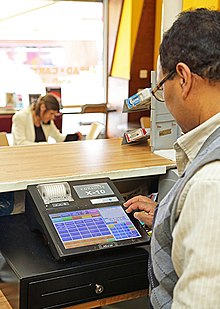
Modern greenbacks register with touchscreen interface
Registers will typically feature a numerical pad, QWERTY or custom keyboard, touch screen interface, or a combination of these input methods for the cashier to enter products and fees by mitt and admission information necessary to consummate the sale. For older registers besides every bit at restaurants and other establishments that do not sell barcoded items, the manual input may be the simply method of interacting with the register. While customization was previously limited to larger chains that could beget to accept physical keyboards custom-congenital for their needs, the customization of register inputs is at present more widespread with the use of touch screens that tin display a variety of point of sale software.
Scanner [edit]

Modern cash registers may be connected to a handheld or stationary barcode reader so that a customer's purchases can be more rapidly scanned than would be possible past keying numbers into the register by paw. The use of scanners should besides help foreclose errors that result from manually inbound the product's barcode or pricing. At grocers, the register's scanner may exist combined with a calibration for measuring product that is sold by weight.
Receipt printer [edit]
Cashiers are often required to provide a receipt to the customer afterward a purchase has been made. Registers typically apply thermal printers to print receipts, although older dot matrix printers are notwithstanding in use at some retailers. Alternatively, retailers tin forgo issuing paper receipts in some jurisdictions by instead asking the customer for an email to which their receipt can exist sent. The receipts of larger retailers tend to include unique barcodes or other information identifying the transaction so that the receipt can be scanned to facilitate returns or other customer services.
Security deactivation [edit]
In stores that use electronic commodity surveillance, a pad or other surface will be attached to the register that deactivates security devices embedded in or attached to the items being purchased. This will prevent a client's purchase from setting off security alarms at the store'southward exit.
Self-service greenbacks register [edit]

Some corporations and supermarkets take introduced cocky-checkout machines, where the customer is trusted to scan the barcodes (or manually identify uncoded items like fruit), and place the items into a bagging area.[18] The pocketbook is weighed, and the machine halts the checkout when the weight of something in the bag does not match the weight in the inventory database. Ordinarily, an employee is watching over several such checkouts to prevent theft or exploitation of the machines' weaknesses (for example, intentional misidentification of expensive produce or dry goods). Payment on these machines is accepted by debit card/credit card, or cash via coin slot and bank notation scanner. Store employees are also needed to authorize "age-restricted" purchases, such as alcohol, solvents or knives, which can either be done remotely by the employee observing the cocky-checkout, or by ways of a "store login" which the operator has to enter.
Run into also [edit]
- Credit menu terminal
- EFTPOS
- Point of sale
- Point of sale display
References [edit]
- ^ "Greenbacks register vs. POS system –what's the difference?".
- ^ "How to Choose a POS Cash Register".
- ^ Cash and Credit Registers, National Museum of American History.
- ^ "Replica of the Ritty Model i Greenbacks Register". National Museum of American History. Retrieved April 7, 2009.
- ^ "On This Day". The New York Times. January 30, 2002. Retrieved May 18, 2014.
- ^ "Inventor of the Week: Annal". Massachusetts Institute of Technology. April 2002. Archived from the original on March 2, 2003. Retrieved April 7, 2009.
- ^ Kerr, Gordon (2013). Book of Firsts. RW Press. ISBN9781909284296.
- ^ Bryson, Bill (1994). Made in America: An Breezy History of the English language in the United States . William Morrow Paperbacks. pp. 114–115. ISBN978-0380713813.
- ^ Brat, Ilan; Zimmerman, Ann (September 2, 2009). "Tale of the Tape: Retailers Take Receipts to Cracking Lengths". The Wall Street Periodical. p. A1. Retrieved September two, 2009.
- ^ "Forum relating to the manufacturing activities at the Hollingbury industrial manor, Brighton, during 1960s". Retrieved July 21, 2009.
- ^ "Gross Cash Registers pictures and company history". Retrieved July 21, 2009.
- ^ "Gross Cash Registers". BBC. 1980.
- ^ "Restaurants, paying the pecker, receipt, check". Ho-hum Travel Italy. Archived from the original on Oct three, 2013. Retrieved September 27, 2013.
- ^ "When in Italia, Proceed That Receipt!". Roderickconwaymorris.com. April 10, 1992. Retrieved September 27, 2013.
- ^ "Type: Bitmap". Papress.com. Archived from the original on March 20, 2014. Retrieved September 27, 2013.
- ^ Wingfield, Nick (April 22, 2013). "Tablets transforming the cash register". The New York Times.
- ^ "Cash Drawers". PCS Applied science Ltd. Archived from the original on April eighteen, 2012. Retrieved April xxx, 2012.
- ^ "IBM Self Checkout Systems". IBM.

What Is It Called When You Scan A Check In A Cash Register,
Source: https://en.wikipedia.org/wiki/Cash_register
Posted by: thomaspregivempank1962.blogspot.com
0 Response to "What Is It Called When You Scan A Check In A Cash Register"
Post a Comment