

How To Preserve A Dead Snake In A Jar
What You Volition Learn Here
- How to preserve dead animals? Here are the v methods to preserve dead animals
- ane. Using 10% Formalin solution & 70% Ethyl or Isopropyl alcohol
- 2. Performing Taxidermy which involves skinning or dehiding the dead animal
- 3. Using Paraffin wax to ensure anaerobic conditions and prevent dehydration of the expressionless creature
- 4. Performing Cryopreservation which involves freezing the dead creature in liquid nitrogen at about -196°C
- 5. Doing Lyophilisation (Freeze-Drying) in which the dead creature is gently frozen, and and so dried under a high-force per unit area vacuum to extract water out of it
- So, Why do we need to preserve specimens?
- What liquid is used to preserve dead animals?
- Tin you preserve a dead animate being in resin?
- Does rubbing booze preserve dead animals?
How to preserve dead animals? Here are the 5 methods to preserve expressionless animals
For the purpose of display, study, and time to come research it is a must that the dead animals are preserved. This will help to keep the body of the dead fauna condom from injury, rotting, and further decay.
Preservation keeps their body intact even after death and such preserved dead animals can exist kept for hundreds of years without much maintenance, and still, the brute itself will look the same as information technology was before its death.
Preserved specimens volition inform united states of america nigh themselves and the time and identify of their collection for the purpose of diverse scientific research.
Nowadays biologists use various methods to preserve dead animals. 1 of the most popular method is to wet-preserve any dead beast by using formalin or ethyl booze.
Other pop preservation techniques are by following report skins, gratuitous-dried mountain, pare mount, preservation in resin, etc.
Below, are 5 of the most well-known methods to preserve dead animals. Check these out:
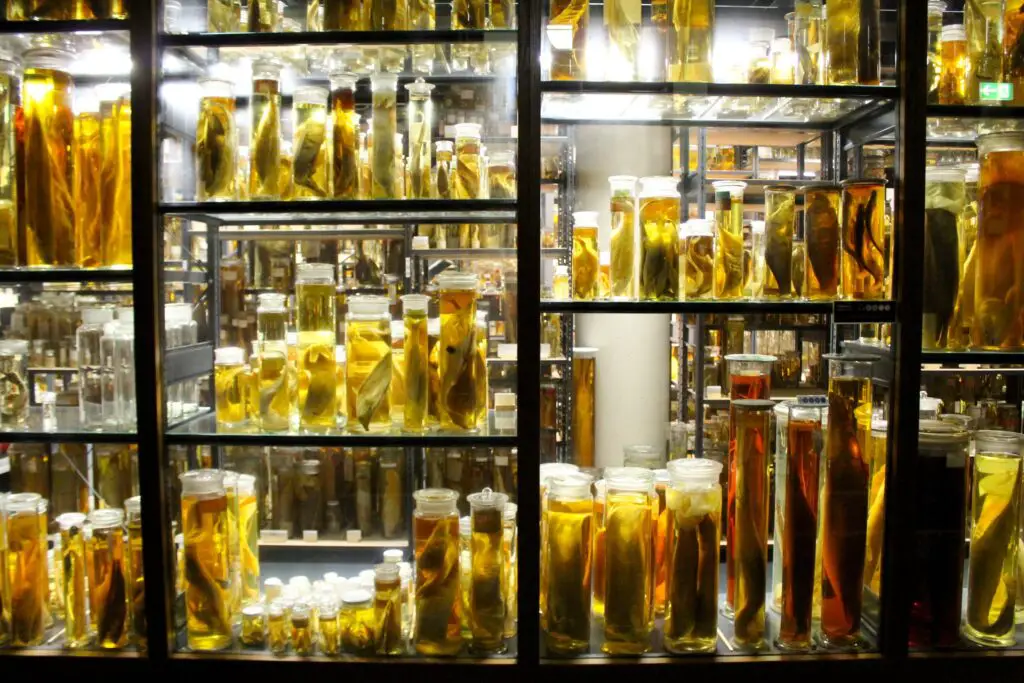
1. Using 10% Formalin solution & 70% Ethyl or Isopropyl alcohol
In this method, we volition commencement collect a freshly dead animal which tin be most of the invertebrates like starfish, earthworm, etc., and vertebrates like fish, frogs, lizards, snakes, etc.
Then we will freeze that specimen for at least near i week within a refrigerator. You tin also continue it inside the deep freezer in your fridge.
Keeping the specimen inside the refrigerator volition cause death to the diverse leaner, maggots, and other parasites that are there inside the dead specimen.
Then we demand to prepare a ten% formalin solution. 10% formalin is a ane:x dilution of 100% formaldehyde in distilled water prepared using a measuring cylinder, i.e.ane part saturated formaldehyde in water diluted with 9 parts of distilled h2o.
Then we take out the specimen out of the refrigerator and let it seat for a while (about ten to 20 minutes).
Then by using a syringe with a sparse needle we inject the ten% formalin solution into the body crenel, limbs, neck, and tail portion of the animal.
This volition give the animal a puffed advent and assist it to regain its shape while fixing and preserving the animal from inside.
Adjacent, we store the specimen inside a closed jar by filling ten% formalin solution inside and keep this jar for about a week or two.
In most of the cases, you will detect that the color of the formalin liquid inside the jar getting blurry and dirty.
Now, it's time to prepare 70% Ethyl alcohol solution or 70% Isopropyl booze solution, whichever you choose both works well.
In order to prepare the alcohol solution take either 100% Ethyl Alcohol or 100% Isopropyl Booze and add distilled water to information technology in the ratio of 7:3, i.due east for every 700 ml of 100% Alcohol add 300 ml of distilled water using a measuring cylinder.
Next, we need to remove the filled formalin out of the jar and fill up the jar with either lxx% Ethyl Alcohol solution or lxx% Isopropyl Alcohol solution and shut the jar with an air-tight pb.
Your dead animal is now preserved inside the jar and will be intact for hundreds of years to come up. Just make certain that you proceed it in a cool, dry, and night place.
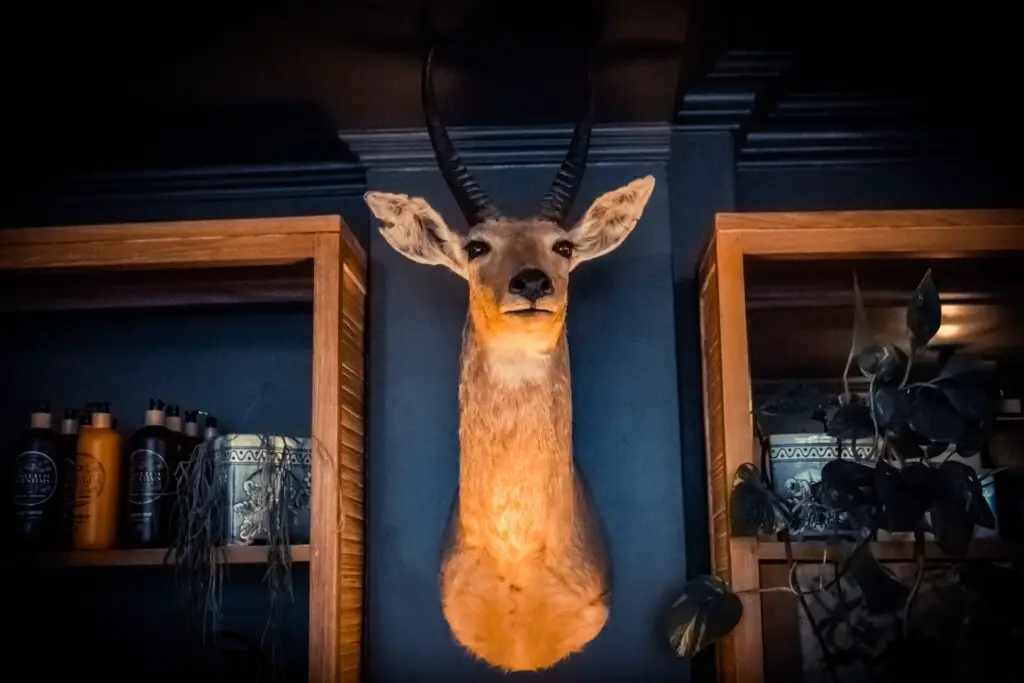
2. Performing Taxidermy which involves skinning or dehiding the dead animal
Taxidermy is the fine art of stuffing animals done by taxidermists in which all of the organs, bones, and tissues of the animal body are removed, while only keeping the skin with fur or feathers impairment-free.
The skin with the fur is then scraped off to remove the extra tissues from inside, cleaned, dried, and then mounted on a framework that volition requite the preserved animal its real wait, stability, and stature.
Taxidermy is usually done to big-sized mammals, birds, fish, reptiles, larger insects, and arachnids. This technique is used to preserve the expressionless fauna in a life-size mount and report skins for keeping in museums mostly.
To do so, first the fresh dead animal is collected and is frozen inside a refrigerator for nigh two to three hours to prevent the growth of whatsoever microbes and parasites.
Adjacent, we need to prepare or purchase a ready-fabricated mount for that animal that tin exist a plaster cast or a wooden mount, or a steel frame.
Then we need to remove the skin forth with the feathers or fur of the beast carefully. For doing so we can make a small cut in the abdomen of the creature and and so peeling out the whole skin off the body.
Recall that skin is the well-nigh important organ for such living-like preservation. So, kindly make sure that you lot don't damage the skin, and also that the fur or feathers must be there attached to the peel.
Here is a catch that you must remember, that y'all can remove the skin from the mammal's head as you would for the balance of the body, but in the case of lizards, fish, and birds, you'll need to remove the brain, eyes, and tongue and leave the shape of the head intact for preservation.
Next, afterward taking out the peel portion of the body, we need to rub a thick layer of non-iodized common salt onto the flesh-side of the hide (peel) and keep that for almost a day or two in a cold dry out place, and after a mean solar day or two days, we chip the actress mankind from the mankind side of the hide.
We need to echo this process with new salt at least 2 to three times. This will aid tan the skin properly later on.
We will find that the skin has now get very tough. So, we need to hydrate the skin using cold distilled h2o along with a small capful of Lysol disinfectant and tabular array table salt.
The side by side chore is to tan the skin with hot oil. Tanning tin exist done by rubbing the oil into the pare with our hands.
Then nosotros can store that tanned pare in a plastic bag within a refrigerator till the time nosotros are ready to mount it.
Next, nosotros use a mixture of glycerin and alcohol and keep it for up to two to three weeks at least in a cool dark place after taking out the skin from the fridge.
At the last phase, we take out the pare from the mixture of glycerin and alcohol, and mount it on a frame, and we fill the skin with the required cotton fiber to make the body of the animal expect similar a living one.
Then subsequently on using an appropriate colored thread, we stitch together the cut portion of the skin to give the animal its shape.
Every bit required we also stick false eyes, teeth, horns, and nails by gluing them in place to the torso of the stuffed animal.
That'south it! Our expressionless stuffed animate being is now preserved and ready for display with a living-like form.
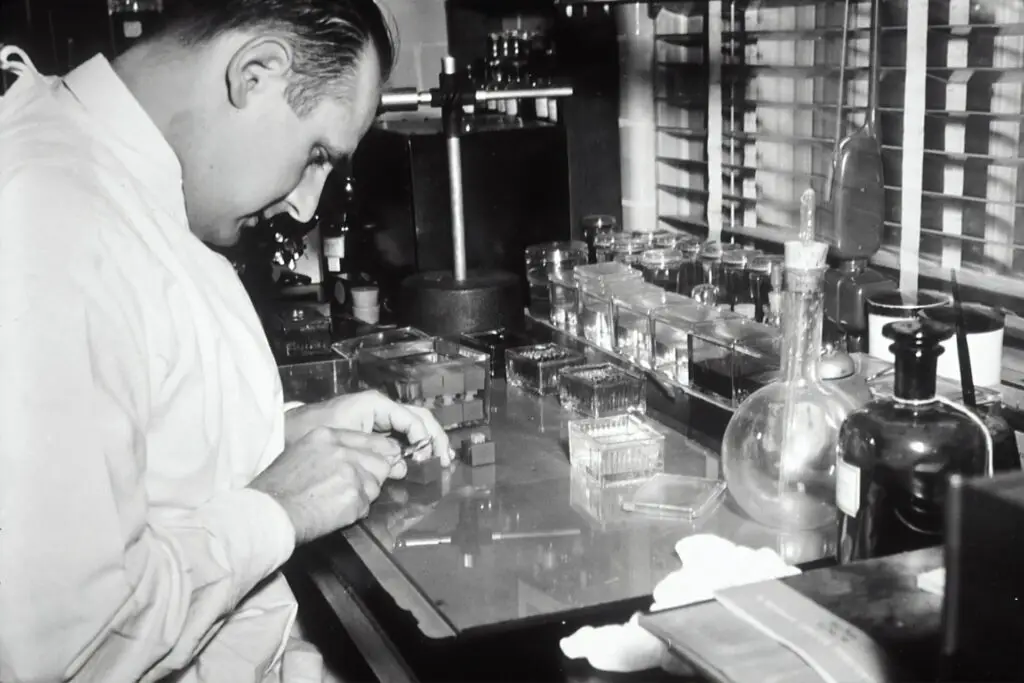
3. Using Paraffin wax to ensure anaerobic atmospheric condition and preclude aridity of the dead brute
Doing preservation using paraffin wax is one of the nearly economical approaches to preserve the parts of expressionless animals.
Information technology is more unremarkably used in histological slides than being used to preserve the whole animal body.
Notwithstanding, small insects like ants, grasshoppers, etc. can exist preserved intact using this technique in a cheap budget-friendly way.
Using this particular technique, it is very piece of cake to preserve the cellular details and morphology of the tissue samples for subsequently studies. And moreover, these preserved materials can last for at least 70 years without any damage to the tissues.
This is also a uncomplicated and most economic method of maintaining pure cultures of bacteria and fungi.
In the case of small insect preservation, the specimen is first collected and is kept properly within a x% formalin solution for at least a day or two.
Formalin is the fixative here and keeping the specimen inside formalin will ensure that the formalin is slowly penetrated into the tissue causing chemical and physical changes that volition harden and preserve the tissue and protect information technology against subsequent processing steps.
Adjacent, information technology's time to be kept in ethanol to dehydrate it. Aridity is necessary because melted paraffin wax is hydrophobic so most of the h2o in a specimen must be removed before information technology can be infiltrated with wax.
So, we accept out the specimen from formalin and placed it in ethanol solution post-obit a typical dehydration sequence.
If the specimen is non more than 10 mm thick then we can follow this typical aridity sequence by placing the specimen in 70% ethanol for 15 minutes, so in 90% ethanol for fifteen minutes, and then in 100% ethanol for 15 minutes, and next in 100% ethanol for another fifteen minutes, next in 100% ethanol for 30 minutes, and at last again in 100% ethanol for another 45 minutes.
Post-obit this typical dehydration sequence will ensure that no water is left inside the specimen. And so the next task is to treat the specimen with a clearing agent similar Xylene.
Xylene will brand sure that the specimen is easy to read past making the tissue transparent and clear. Likewise, that Xylene will act equally an intermediate solvent between ethanol and paraffin wax.
This is so considering wax and ethanol are largely immiscible. So nosotros need to use an intermediate solvent like Xylene that is fully miscible with both ethanol and paraffin wax.
If the specimen is not more than than 10 mm thick then we tin follow this immigration sequence by placing the specimen in Xylene for xx minutes, and so once more in Xylene for 30 minutes, and then once again in Xylene for the adjacent 45 minutes.
The tissue can now be infiltrated with suitable paraffin wax. This is done by melting paraffin wax at 60°C and so pouring it on the specimen placed inside a mould through a filter paper.
And, and then the mould is allowed to absurd to twenty°C to form a block with the specimen within it.
So, using Methane series wax in preservation ensures anaerobic conditions and prevents dehydration of the dead animal.
This animal tin can exist now taken out of the wax cake if required in the future or tin can be cut into thin sections using a microtome to prepare histological slides.
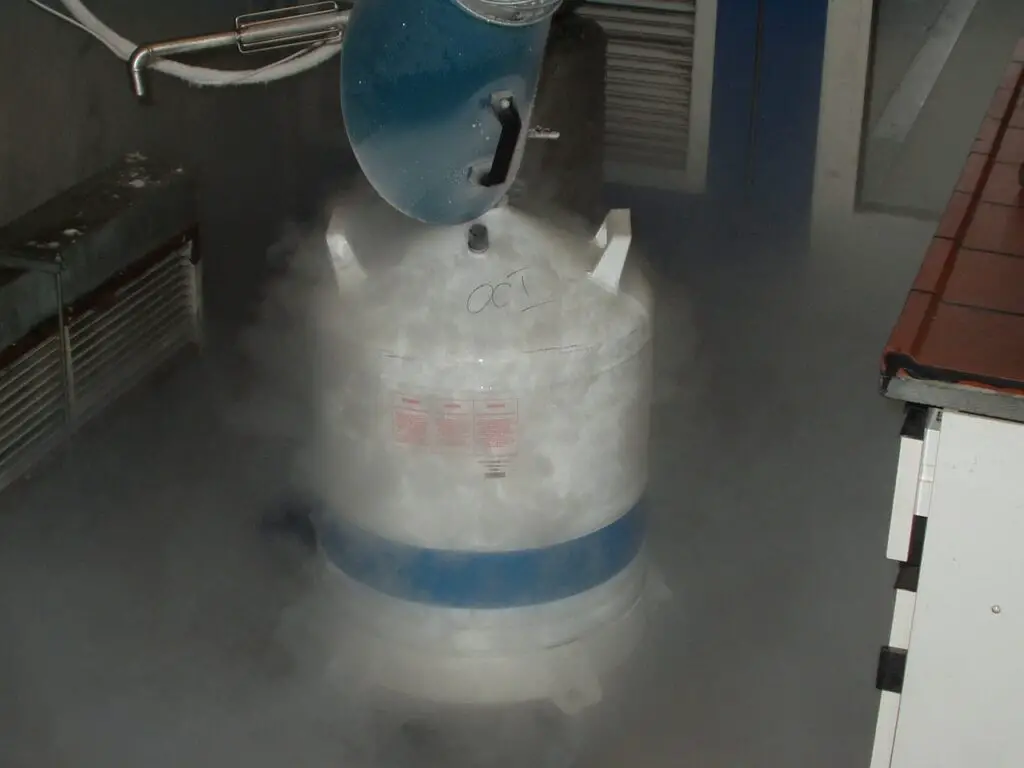
4. Performing Cryopreservation which involves freezing the expressionless creature in liquid nitrogen at about -196°C
Cryopreservation is actually a very expensive process for preserving any dead animal. It is only done in selective laboratories effectually the world, and non everywhere.
Liquid nitrogen is used in the cryopreservation technique. The reason is that during cryopreservation the cells organelles, cells, tissues, organs, or any other biological stuff of the body is preserved by cooling the samples to extremely low temperatures past keeping them inside the liquid nitrogen.
In this technique, the animal to be preserved or cultured is speedily frozen past putting it in liquid nitrogen at -196°C in the presence of stabilizing agents such equally glycerol, that forestall the formation of ice crystals.
Yes, nosotros can utilize this technique to preserve dead animals, but no such high advancements are seen in this technique for preserving the full animal body. So, moisture preservation using alcohol and formalin, and likewise dry out preservation using stuffing are best suggested.
Cryopreservation'southward main aim is mostly to preserve living cells and not the dead ones. And and so, this procedure of cooling and storing cells, tissues, or organs at very low temperatures is mostly performed to maintain their viability and chances of survival of these biological samples for a longer duration of time,
In cryopreservation, diverse effective techniques are being adult in order to preclude cell death and damage after the biological samples are taken out of liquid nitrogen and warmed up.
For the dead animals that were beingness preserved using cryopreservation will just help to go along their cells intact and structured and volition not in whatever way make the cells viable once more since the cells were already expressionless.
Actually, the primary purpose of cryopreservation is merely to interruption the living cell's metabolism with ultralow temperatures, and then that the cells can exist preserved and used subsequently on by the freeze-thaw procedure.
5. Doing Lyophilisation (Freeze-Drying) in which the expressionless animal is gently frozen, and then stale under a loftier-pressure vacuum to extract water out of it
The preservation process of Lyophilisation is also called the Freeze-drying procedure or Cryodesiccation process.
This is more often than not used to preserve pocket-sized biological specimens like bacteria, yeast, and mammalian cells every bit well.
This process involves slowly freezing the specimen and and so lowering the pressure and calculation heat to remove the ice crystals past sublimation.
The principle involved here is to perform sublimation of water at temperature and pressure below its triple betoken, that is, 611 Pascal and 0.0098 caste Celsius.
This is really a process through which all of the water and fluid contents from the specimen are removed between the drying front and the condenser only in order to extend its preservation time.
Now, it is also to be noted that in order to protect the dehydration-sensitive specimens unlike poly-hydroxy compounds such equally sugars, polyalcohols, and their derivatives are used in lyophilisation.
Among the diverse poly-hydroxy compounds, the non-reducing disaccharides similar trehalose and sucrose are the nigh popular considering they are used by virtually every anhydrobiotic brute.
Remember that but the cell lines and not the whole dead body of the brute are preserved using this technique.
This technique is less commonly used to preserve dead higher vertebrates, and that the wet-preservation technique using formalin and alcohol mentioned in a higher place is used the well-nigh for consummate dead body preservation.
And so, Why do we need to preserve specimens?
Preservation of Specimens is very important just in order to ensure a high-quality specimen is conserved for years to come up, while withal maintaining the integrity, quality of data of the specimen, as well as its construction even later the expiry of the specimen.
Specimens must be preserved well so that the biological content doesn't become decayed and decomposed afterward the death of the animals. This ensures that expressionless animals are ever there for future reference.
Preserved specimens are actually the gold mines that provide many opportunities for biological studies, ranging from detailed research to casual field observations.
The preserved animals are very much essential to written report the various ecological relationships between species, their environment, habitat, trophic levels, etc
It helps researchers to know the animal's evolutionary patterns, ecosystem, morphology, behavior, taxonomy, life bike, and ecology conditions that prevailed during the time the beast was alive.
But you tin consider the specimens that are found in diverse museums. These preserved specimens that are kept here forth with the data provided on the specimen labels constitute a historic record of biological diversity and these are used as a reference to document diverse changes in distribution and abundance of species over time.
What liquid is used to preserve dead animals?
Alcohols like Ethyl alcohol and Isopropyl alcohol are used to preserve dead animals. Glycerin can also be used as a preservative, and if used and then it may prevent desiccation or dehydration of the specimen if the container lid is loose.
Ethanol (Ethyl Alcohol) is always the best liquid preservative and is used the about as compared to Isopropanol (Isopropyl Alcohol).
Others like Bouin's fluid, Carnoy'due south fluid, and Formalin Acerb Acid Alcohol (F.A.A.) tin also be used as both fixative and preservative, just their pattern of use is a bit different from ethanol and isopropanol.
Normally, 70% ethanol or isopropyl alcohol is used for preservation. And that ethanol is used the most than Isopropanol because Isopropanol doesn't harden specimens every bit much as ethanol does by dehydrating it.
Actually, the apply of preservatives like ethanol and isopropanol is that these fluids dehydrate the specimen by driving out water from the tissue and cells.
If ethanol is not present we can use isopropanol, and if both are non nowadays then we must apply Denatured alcohol. But, for a long time preservation ethanol is always suggested.
95% to 100% ethanol is always considered an excellent killing agent and preservative, only the apply instance strictly depends on the specimen you want to preserve.
It is also to be noted here that if the ethanol kept specimen is stored in common cold refrigerator condition then the DNA also remains preserved for over a hundred years time period along with the specimen.
People often misfile formalin being a preservative, but hither it is to be noted that formalin is not a preservative just a fixative. Fixative is that fluid that stops the deterioration and decay process of the biological specimen.
In fact, formalin is an clarified, disinfectant, and is particularly used today every bit a fixative in biological preservations.
Tin can you preserve a dead brute in resin?
Mostly, insects are preserved in resins to give those dead ones a beautiful await and design while still preserving them for the purpose of diverse entomological studies and decorations as well.
Insects that are preserved in resins look like they accept been well-fitted inside a transparent glass box all around information technology.
This glass-like transparent structure is cypher simply the stale resin actually which gives the expressionless specimen that is placed inside a very decorative expect, and also makes it articulate to see the specimen inside it.
To preserve a dead insect in resin nosotros collect a recently expressionless insect. If the insect had died a few days back so information technology may have been deformed, decayed, and cleaved in various body parts, so nosotros must always choose a freshly dead insect for preserving in resin.
Next, we keep that insect in 80% alcohol for about 24 hours and let it dehydrate. This will remove costless water from the tissue so that proteins tin coagulate and precipitate.
Adjacent, afterwards 24 hours we take that insect out of alcohol and let it dry for about v to 10 minutes in the open air.
And so, we place the insect in a mould depending on the size of the insect. Next, nosotros prepare the liquid resin solution that is to be filed within the mould.
If you lot buy resin that comes with a catalyst, the package will tell you how many catalysts to add.
Next, you lot need to measure the depth of the mould and fill up halfway of the mould with liquid resin.
Then we place the insect on top of the resin, and carefully center it, and let the resin harden for about 15-20 minutes until it turns to gel.
This volition make sure that the insect doesn't get up to the surface of the mould while getting filled with the resin.
Next, after that, we fill the mould completely with the resin and let it harden past keeping it in a cool, dry identify so that our mold can cure properly.
Nosotros check back after iii to 4 days, and till this time period, the mould volition be hard with the resin.
While pouring the resin inside the mould it is always important that you maintain a dull and constant pour and then that air bubbles don't form inside the resin, or else the slice won't await and so professional.
Adjacent, we remove the hardened resin construction from the mould past gently pressing it from behind.
Always make sure not to hard press it or there may be some cleaved, chipped, or croaky spots in the hardened resin.
If you are using prophylactic moulds then information technology is the best. So, once the resin has finished drying, skin back the rubber mould to remove the resin.
Well, the preservation of the insect is successfully done with the insect being fitted inside the hardened resin for hereafter reference, study, and decorations. This preservation will exist intact and safe for the adjacent hundreds of years to come.
Does rubbing alcohol preserve dead animals?
Rubbing alcohol is merely liquid alcohol which is either isopropanol or ethanol or denatured ethanol-based mixed with various bitterants.
It is but a very cooling, soothing, colourless, volatile, and flammable liquid that contains a 70% solution of denatured ethanol or isopropanol.
And yep, rubbing alcohol can exist used every bit a preservative to preserve dead animals. To do this, we follow the moisture-preservation technique using formalin and booze.
We offset need to use ten% formalin as a fixative for the specimen and then post-obit the afterward processes we place information technology inside an air-tight container filled with rubbing alcohol.
Never ever wait that by simply placing a dead animal in rubbing alcohol volition preserve information technology properly. In fact, it volition offset to rot slowly after a few years. Then, follow the right pattern of preservation using a fixative similar formalin.
Just annotation that all kinds of insects can be all-time preserved using rubbing booze. However, there are some insects similar spiders, scorpions, earthworms, etc. that need stronger rubbing alcohol at around 80% or 85% alcohol concentration.

Source: https://onlyzoology.com/how-to-preserve-dead-animals-ways-to-preserve-more-things-to-know/
0 Response to "How To Preserve A Dead Snake In A Jar"
Post a Comment